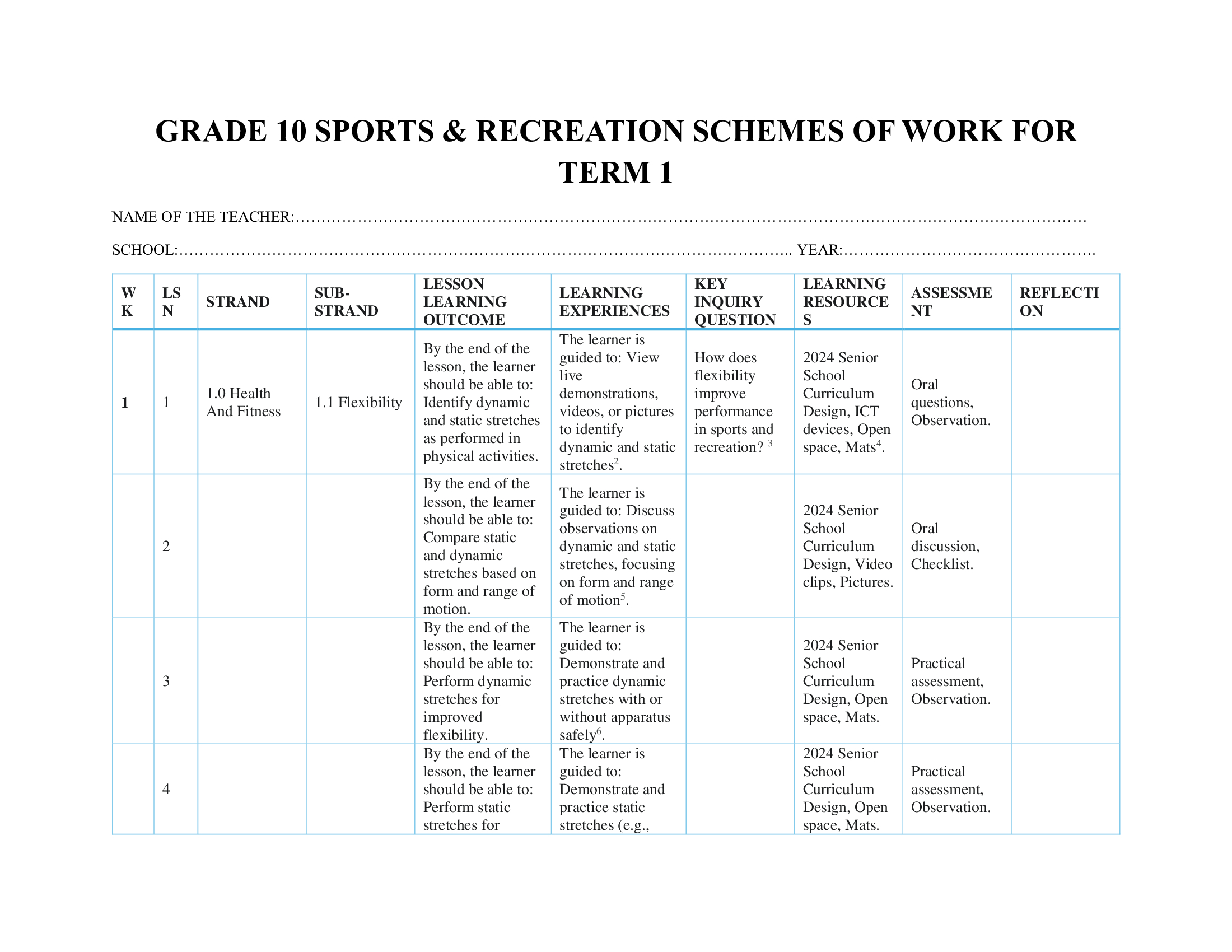
What to expect:
Title: Grade 10 Sports and Recreation Schemes of Work Term 1
- Class:Grade 10
- Level:Senior Secondary
- Document Type:Ms Word Doc (Editable)
- Number of Pages: 13
Summary
This MS Word document contains the complete Grade 10 Sports and Recreation Schemes of Work Term 1, 2026. A PDF version can also be provided upon request.
The schemes cover 6 lessons per week and are organized under the following strand and sub-strands:
Strand 1.0: Health and Fitness
Sub-strand 1.1: Flexibility
Identifying and comparing dynamic and static stretching techniques.
Demonstrating proper execution of both dynamic and static stretches with balance and fluid coordination.
Critiquing peers’ stretching demonstrations.
Enhancing flexibility through structured games.
Performing advanced stretching routines for warm-up and cool-down sessions.
Appreciating the role of stretching in health, performance, and disease prevention.
Sub-strand 1.2: Muscular Strength and Endurance
Differentiating between muscular strength and muscular endurance.
Identifying and improvising materials to create simple weights.
Performing strength and endurance exercises using improvised weights and bodyweight (push-ups, squats, etc.).
Developing strength and endurance through mini-games.
Evaluating peers’ performance and applying safety measures during training.
Sub-strand 1.3: Cardiovascular Endurance
Examining the physical, health, and performance benefits of cardiovascular endurance.
Participating in low-impact activities (walking, cycling) and high-impact activities (running, skipping).
Taking part in interval training and group fitness sessions.
Applying cardiovascular endurance in sport-specific activities while practicing safe play.
Assessing personal endurance levels (e.g., timed running test).
Sub-strand 1.4: Posture for Performance
Distinguishing between correct and defective posture in sitting, standing, and walking.
Analyzing posture during running, jumping, throwing, and kicking.
Demonstrating correct posture in various movements.
Identifying common postural defects (kyphosis, lordosis, scoliosis).
Performing corrective exercises to improve posture.
Applying proper posture in sports to enhance performance and reduce injuries.
Sub-strand 1.5: Recreation and Wellness
Outlining the impact of physical activity on overall wellness.
Exploring the dimensions of wellness: physical, emotional, intellectual, spiritual, social, and mental.
Participating in recreational activities that promote holistic well-being.
Sharing feedback on recreation outcomes and demonstrating competence in selected activities.
Sub-strand 1.6: Injuries in Sports
Classifying common sports injuries (acute and chronic) and identifying their causes.
Examining acute injuries (sprains, fractures) and chronic injuries (tendinitis, overuse).
Assessing strategies for preventing injuries and applying safe play habits.
Implementing safety routines such as proper warm-up and equipment inspection.
Demonstrating an injury-prevention matrix and embracing safety practices in sports.
Main Reference:
KICD Curriculum Design for Sports and Recreation.
Preview first pages below for more details