What to expect:
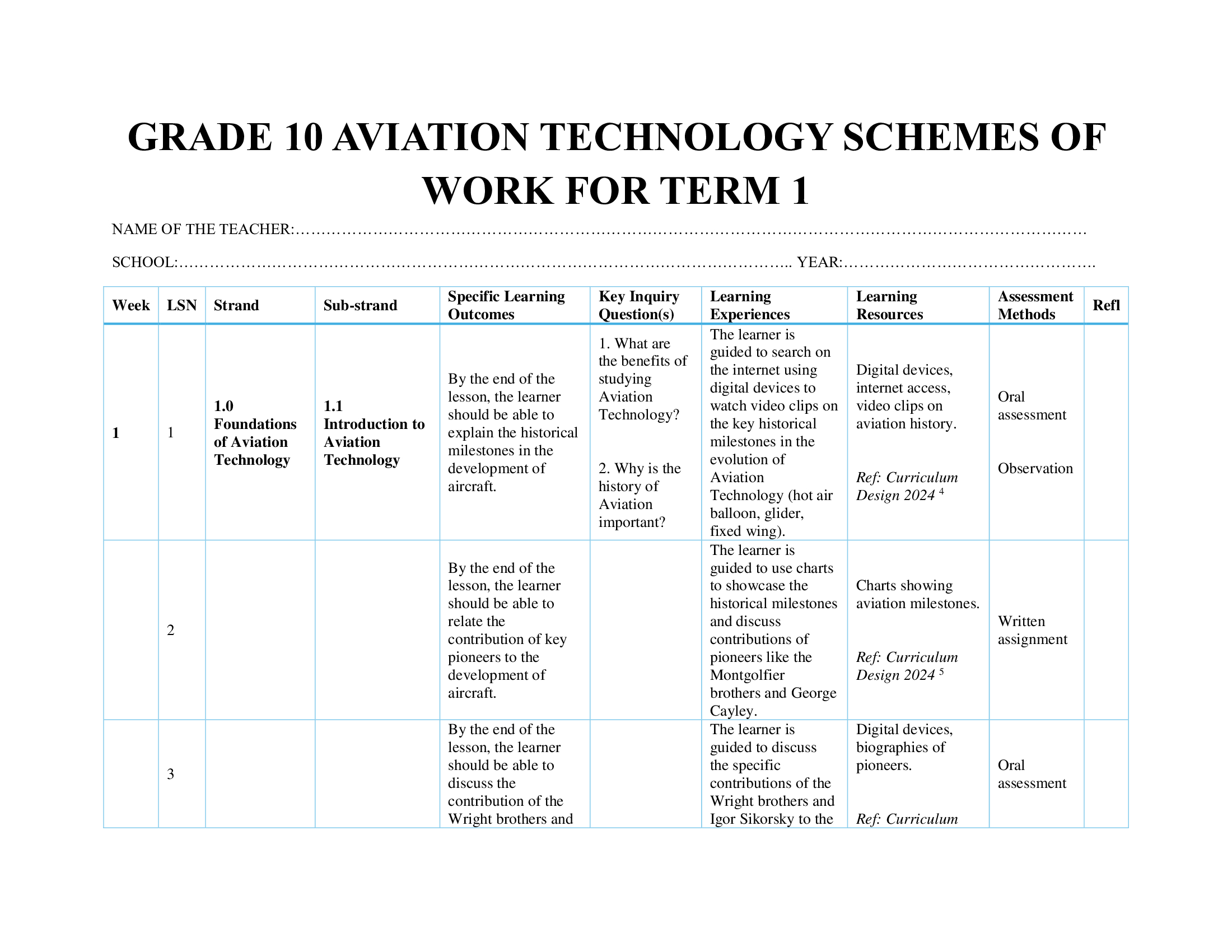
Title: Grade 10 Aviation Technology Schemes of Work Term 1-2026
- Class:Grade 10
- Level:Senior Secondary
- Document Type:Ms Word Doc (Editable)
- Number of Pages: 11
Summary
This MS Word document contains the Grade 10 Aviation Technology Schemes of Work Term 1-2026.
A PDF version can also be provided upon request.
The schemes follow 4 lessons per week, structured to support effective and progressive learning throughout the term.
The primary reference material is the KICD Curriculum Design for Aviation Technology (Grade 10).
The schemes of work comprehensively cover the following strands, sub-strands, and key content areas:
Strand 1.0: Foundations of Aviation Technology
Sub-strand 1.1: Introduction to Aviation Technology
Historical milestones in aircraft development (hot air balloon, glider, fixed wing).
Contributions of aviation pioneers: Montgolfier Brothers, George Cayley, Wright Brothers, Igor Sikorsky.
Categories and functions of aircraft: lighter-than-air and heavier-than-air.
Sub-strand 1.2: Safety in the Aviation Workplace
General rules and hazards affecting personal safety in aviation environments.
Classification of common injuries (cuts, burns, scalds, fractures).
First aid kit items and basic first aid procedures, including CPR.
Observation and application of aviation workplace safety practices.
Sub-strand 1.3: Airport Safety
Safety measures in the landside, airside, and terminal areas of an airport.
Classification of safety signs (mandatory, prohibition, information).
General safety rules governing movement within airport zones.
Entry and exit safety requirements in airport facilities.
Strand 2.0: Aircraft Basic Construction
Sub-strand 2.1: Aircraft Components
Functions of the fuselage, wing, empennage, and landing gear.
Functions of the power plant, main rotor, and tail rotor.
Illustration of fixed-wing and rotary-wing aircraft parts.
Modeling of a heavier-than-air aircraft.
Sub-strand 2.2: Aircraft Tools and Materials
Properties of metals and non-metals used in aircraft construction.
Investigation of mechanical and physical characteristics of aviation materials.
Functions and grouping of aircraft tools:
Non-powered tools
Powered tools
Cutting, striking, holding, marking, measuring tools
Safety precautions and maintenance of aviation tools and materials.
Preview first pages below for more details