What to expect:
Title: Grade 10 Biology Schemes of Work Term 1-2026
- Class:Grade 10
- Level:Senior Secondary
- Document Type:Ms Word Doc (Editable)
- Number of Pages: 8
Summary
The MS Word document comprises Grade 10 Biology Schemes of Work Term 1-2026. A PDF version is also available upon your request.
The schemes of work cover 4 lessons per week and are developed using the KICD Curriculum Design for Biology as the primary reference.
The document includes the following strands, sub-strands, and detailed topics:
Strand 1.0: Cell Biology and Biodiversity
Sub-strand 1.1: Introduction to Biology
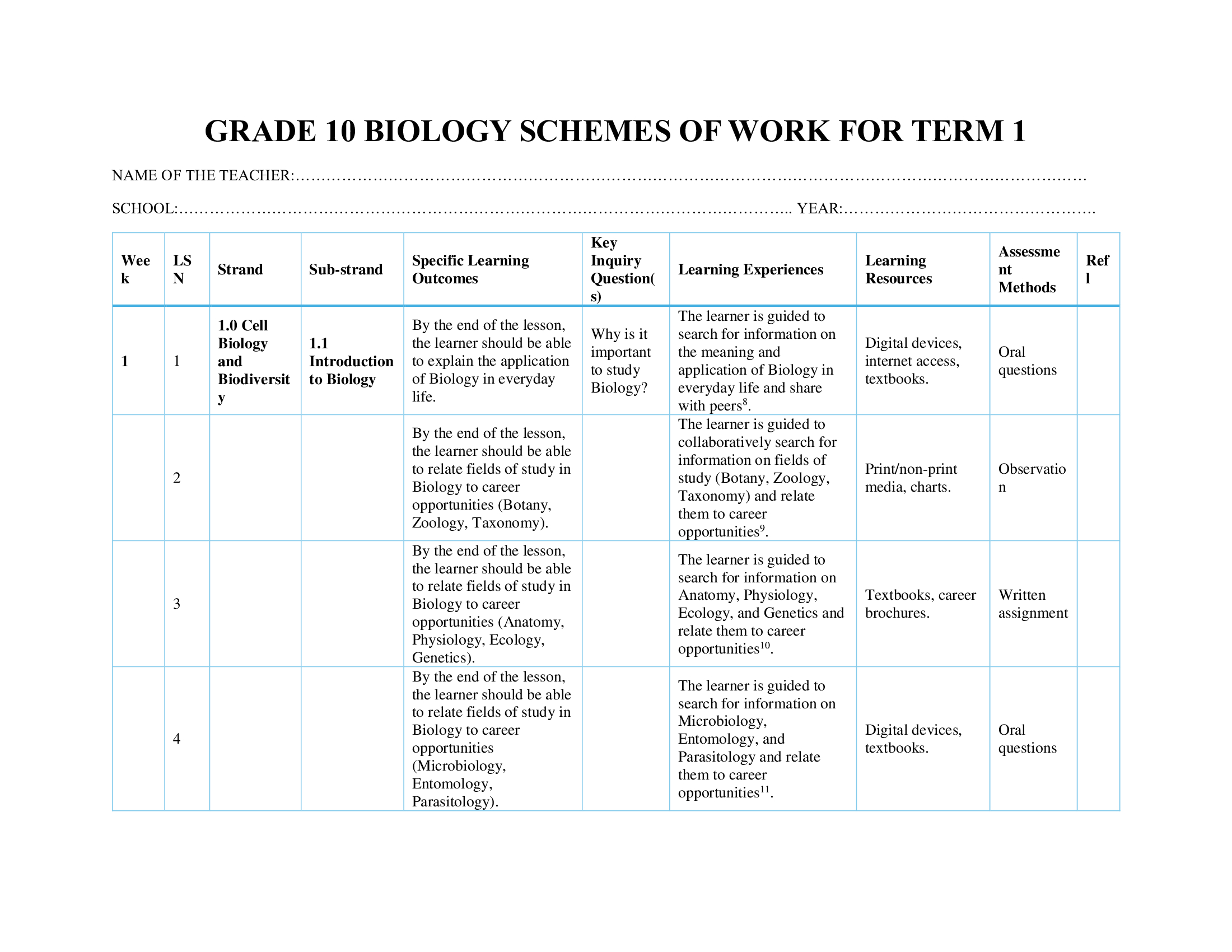
Application of Biology in everyday life.
Relating fields of study such as Botany, Zoology, Taxonomy, Anatomy, Physiology, Ecology, Genetics, Microbiology, Entomology, and Parasitology to career opportunities.
Factors influencing career choices in Biology and developing a career wheel.
Sub-strand 1.2: Specimen Collection and Preservation
Identification of apparatus used for specimen collection (pooter, pitfall trap, sweep net).
Identification of materials for processing and preservation (forceps, light traps, Tullgren funnel, envelopes).
Improvisation of apparatus using locally available materials.
Collection of plant specimens and preparation of a herbarium (pressing, mounting, labeling).
Collection, processing, and preservation of small animals (wet preservation using ethanol, mounting on soft boards).
Planning and carrying out a project on specimen collection.
Sub-strand 1.3: Cell Structure and Specialization
Differences between light and electron microscopes based on resolution, magnification, and structural features.
Preparation of temporary slides: sectioning, staining, and mounting procedures.
Estimation of cell size using a light microscope.
Description, drawing, and labeling of plant and animal cells as seen under an electron microscope.
Modeling the structure of plant and animal cells.
Relating specialized plant cells—root hair, palisade, guard cells, pollen grains—to their functions.
Relating specialized animal cells—muscle, nerve, blood, reproductive cells—to their functions.
Levels of organization: from organelles to cells, tissues, organs, and organ systems.
Preview first pages below for more details