What to expect:
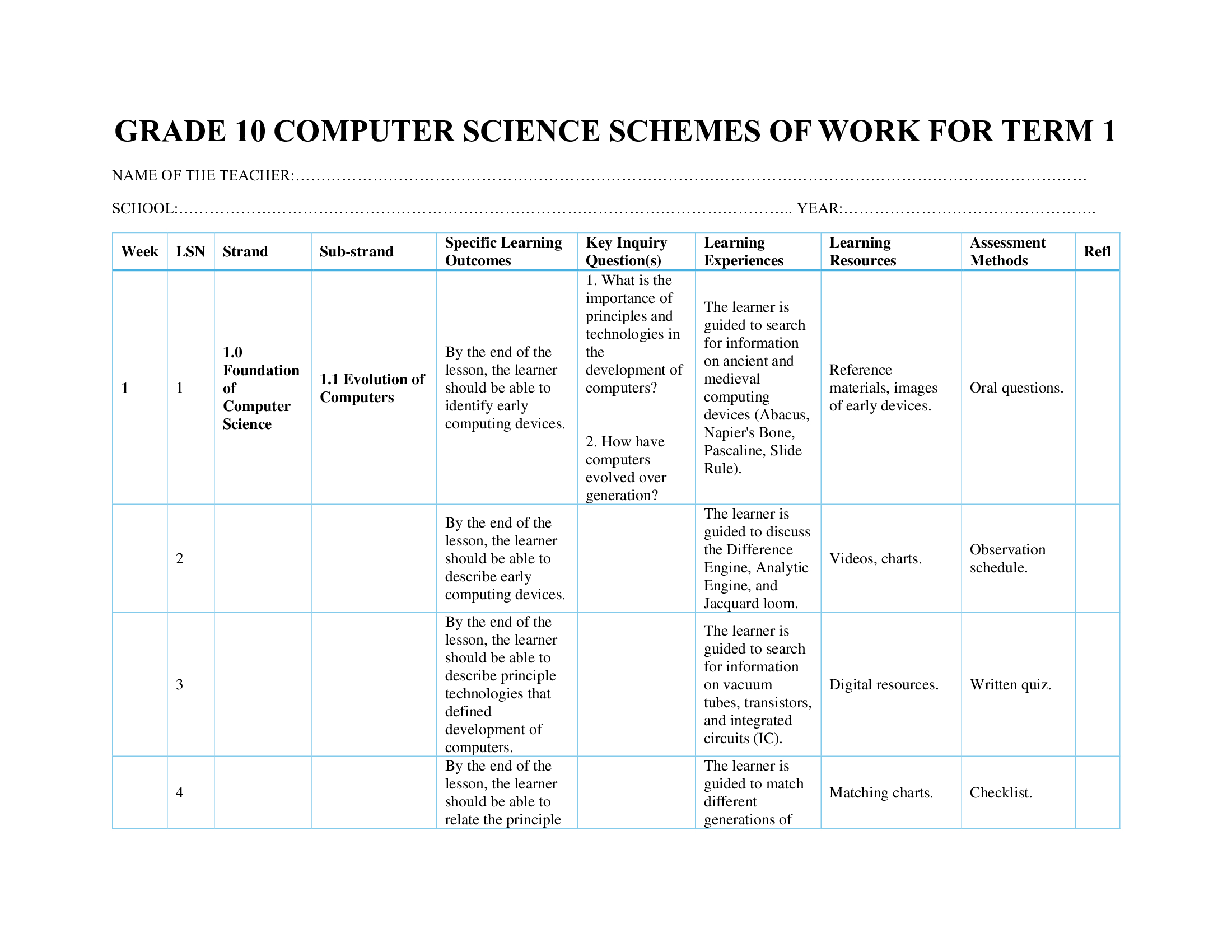
Title: Grade 10 Computer Science Schemes of Work for Term 1
- Class:Grade 10
- Level:Senior Secondary
- Document Type:Ms Word Doc (Editable)
- Number of Pages: 14
Summary
This MS Word document comprises Grade 10 Computer Science Schemes of Work for Term 1, 2026. A PDF version is also available upon request.
The schemes of work cover 6 lessons per week.
The main reference material is the KICD Curriculum Design for Computer Science.
Strands, Sub-Strands, and Topics Covered
1.0 Foundations of Computer Science
1.1 Evolution of Computers
Ancient and medieval computing devices (Abacus, Napier’s Bone, Pascaline, Slide Rule)
Mechanical devices (Difference Engine, Analytic Engine, Jacquard Loom)
Principal technologies (Vacuum Tubes, Transistors, Integrated Circuits)
Generations of computers (First to Fifth)
1.2 Computer Architecture
Functional organization of a von Neumann computer (Input, Processing, Output, Storage, Buses)
Relationships among the functional elements
Number systems (Decimal, Binary, Octal, Hexadecimal)
1.3 Input/Output (I/O) Devices
Keying and pointing devices
Scanning and voice input devices
Advanced input devices (Digital Cameras, QR Codes, 2D/3D Scanners)
Output devices (Printers, Monitors, Speakers, Projectors)
Criteria for selecting input and output devices
Creation and comparison of QR Codes and Barcodes
1.4 Computer Storage
Primary memory (RAM, ROM) and RAM technologies (DRAM, SRAM)
Secondary storage devices (HDD, SSD, DVD, Flash Drives)
Data operations (Read, Write, Save, Transfer)
Remote storage and selection criteria
1.5 Central Processing Unit (CPU)
Structural elements (ALU, CU, Registers)
The Fetch–Decode–Execute cycle
Types of CPUs and factors to consider during selection
1.6 Operating System (OS)
Functions and classification of operating systems
Installation procedures (Preparation and Virtual Environment Setup)
File and system management tasks
1.7 Computer Setup
Types of ports and cables
Tools and safety precautions during setup
Connecting and testing computer components
Reusing and managing e-waste
2.0 Computer Networking
2.1 Data Communication
Basic concepts (Data, Signals, Channel, Network)
Components of a data communication system
Data transmission terms (Bandwidth, Baud Rate, Digital/Analog Signals)
Modes of data flow (Simplex, Half-Duplex, Full-Duplex)
2.2 Data Transmission Media
Wired media (Twisted Pair, Coaxial, Fiber Optic)
Wireless transmission media
Data transmission illustrations (Encoding, Modulation, Multiplexing)
Transmission impairment (Attenuation, Noise)
Preview first pages below for more details