What to expect:
Title: Grade 10 Metal Technology Schemes of Work for Term 1
- Class:Grade 10
- Level:Senior Secondary
- Document Type:Ms Word Doc (Editable)
- Number of Pages: 11
Summary
This MS Word document comprises the Grade 10 Metal Technology Schemes of Work for Term 1, 2026. A PDF version is also available upon request.
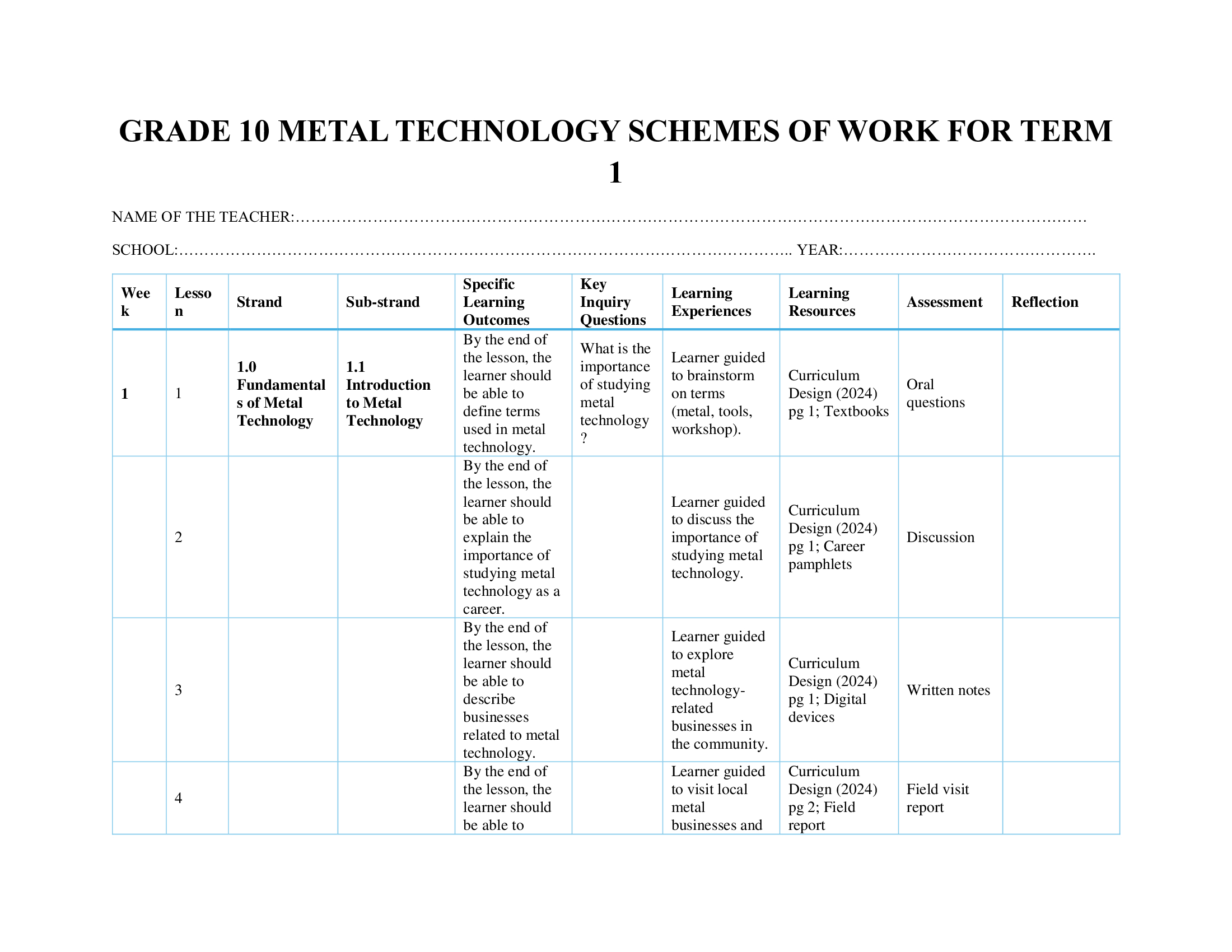
The schemes of work cover 6 lessons per week and include the following strands, sub-strands, and key learning areas:
Strand 1.0: Fundamentals of Metal Technology
Sub-strand 1.1: Introduction to Metal Technology
Definition of key terms used in metal technology.
Importance of studying metal technology as a career field.
Businesses and job opportunities related to metal technology within the community.
Appreciation of the role of metal technology in daily life.
Sub-strand 1.2: Safety in the Workshop
Safety practices in a metal workshop (personal, equipment, and environmental safety).
Workshop rules and regulations guided by OSHA.
Possible causes of accidents in a workshop setting.
First aid procedures and demonstrations for injuries such as cuts and burns.
Components of an efficient workshop layout.
Observation and assessment of safety measures in local workshops.
Strand 2.0: Tools and Materials
Sub-strand 2.1: Hand Tools and Bench Tools
Identification and use of cutting tools: hacksaws, files.
Identification and use of driving tools: hammers, mallets.
Identification and use of holding tools: vices, clamps.
Selection of appropriate tools for specific tasks.
Practical activities: filing, sawing, and hand drilling.
Maintenance of cutting, driving, and holding tools.
Proper storage and handling of hand tools.
Identification and use of bench shears/snips and cold chisels.
Cleaning and organization of the workbench area.
Sub-strand 2.2: Measuring and Marking Out Tools
Identification of measuring tools: steel rule, tape measure.
Identification of marking out tools: scriber, dot punch, centre punch.
Identification of checking tools: try square, callipers.
Identification of layout tools: surface table, V-block.
Practical use of steel rules, scribers, punches, and dividers.
Using inside, outside, and odd-leg callipers.
Setting up and using scribing blocks.
Maintenance and proper care of measuring and marking out tools.
Template making and layout exercises.
Sub-strand 2.3: Ferrous and Non-Ferrous Metals
Differences between ferrous and non-ferrous metals.
Identification of ferrous metals: iron, steel.
Identification of non-ferrous metals: copper, aluminium, tin, lead, zinc.
Types of ferrous metals: mild steel, high carbon steel.
Physical and mechanical properties of metals.
Process of iron production from ore.
Forms in which metal materials are supplied: sheets, plates, bars.
Uses of ferrous and non-ferrous metals in everyday life.
The main reference material is the KICD Curriculum Design for Metal Technology.
Preview first pages below for more details