What to expect:
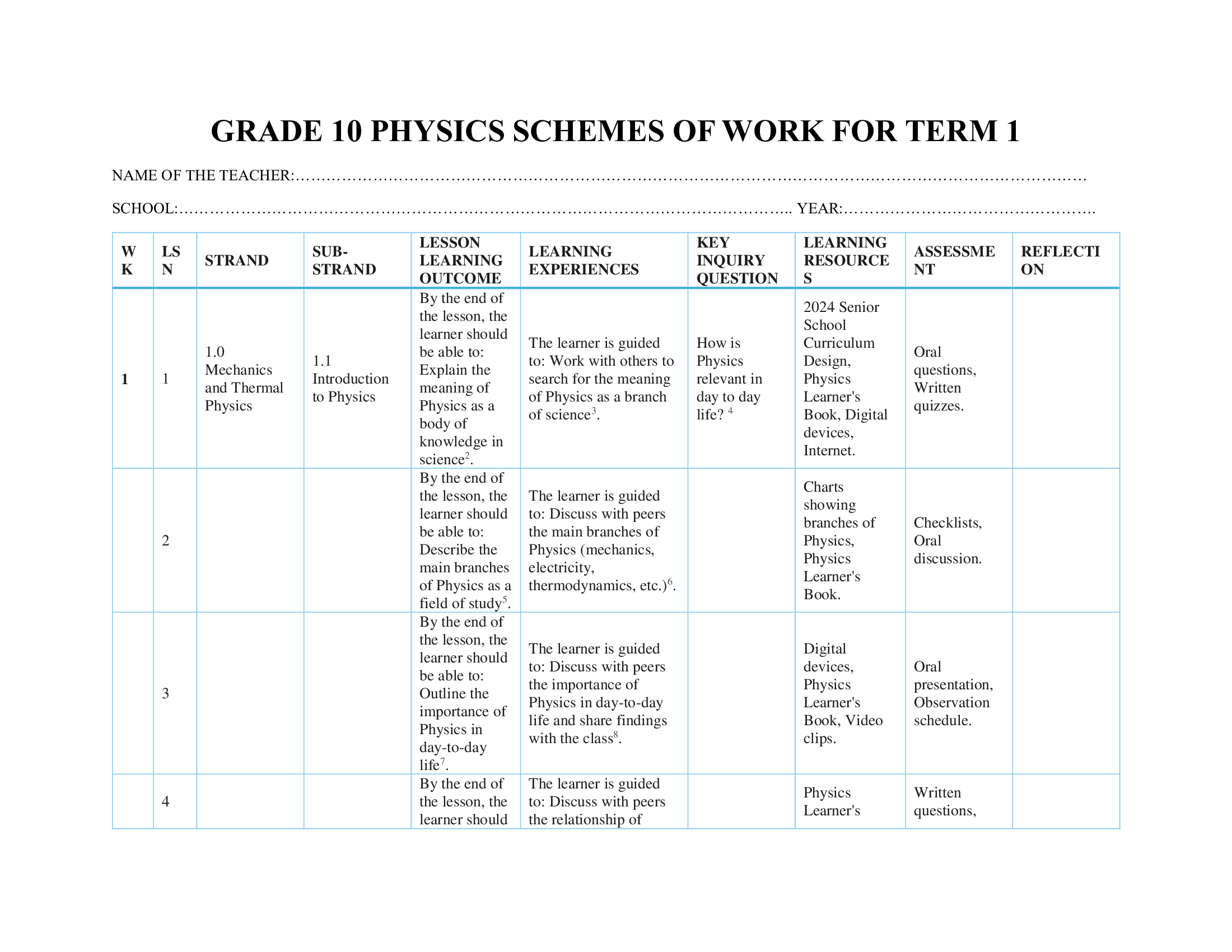
Title: Grade 10 Physics Schemes of Work for Term 1
- Class:Grade 10
- Level:Senior Secondary
- Document Type:Ms Word Doc (Editable)
- Number of Pages: 11
Summary
This MS Word document contains the Grade 10 Physics Schemes of Work for Term 1, 2026. A PDF version is also available upon request.
The schemes of work cover 4 lessons per week.
Strand 1.0: Mechanics and Thermal Physics
Sub-strand 1.1: Introduction to Physics
Meaning of Physics as a body of knowledge.
Main branches of Physics: mechanics, electricity, thermodynamics, etc.
Importance of Physics in everyday life.
Relationship between Physics and other fields (Biology, Geography, Chemistry).
Career opportunities related to Physics.
Developing simple career charts illustrating areas linked to Physics.
Sub-strand 1.2: Pressure
Description and demonstration of atmospheric pressure.
Effect of density and depth on pressure in liquids.
Derivation and use of the formula P = ρgh.
Transmission of pressure in fluids (Pascal’s Principle).
Application of pressure in hydraulic systems (e.g., hydraulic lifts).
Working mechanisms of everyday devices: drinking straws, syringes, siphons.
Operation of bicycle pumps, lift pumps, and force pumps.
Sub-strand 1.3: Mechanical Properties of Materials
Properties of materials: ductility, malleability, elasticity, brittleness.
Strength, hardness, and stiffness of materials.
Relationship between tensile force and extension (Hooke’s Law).
Calculation of tensile stress, tensile strain, and Young’s Modulus.
Interpretation of stress–strain curves (elastic limit, yield point, breaking stress).
Applications of mechanical properties in industry and everyday situations.
Sub-strand 1.4: Temperature and Thermal Expansion
Meaning of temperature and units of measurement.
Measuring temperature using liquid-in-glass thermometers.
Bimetallic strips and thermocouple thermometers.
Modern temperature devices: RTDs, thermistors, infrared thermometers.
Thermal expansion in solids (ball-and-ring experiment) and in fluids.
Determination of the linear expansivity of metals.
Anomalous expansion of water and its ecological importance.
Applications of thermal expansion: thermostats, railway/bridge expansion joints, etc.
Main Reference:
KICD Curriculum Design for Physics.
Preview first pages below for more details