What to expect:
Title: Bridges Without Rivers Summary Notes
- Class: English set book
- Level: English set book
- Document Type:PDF
- Number of Pages: 38
Summary
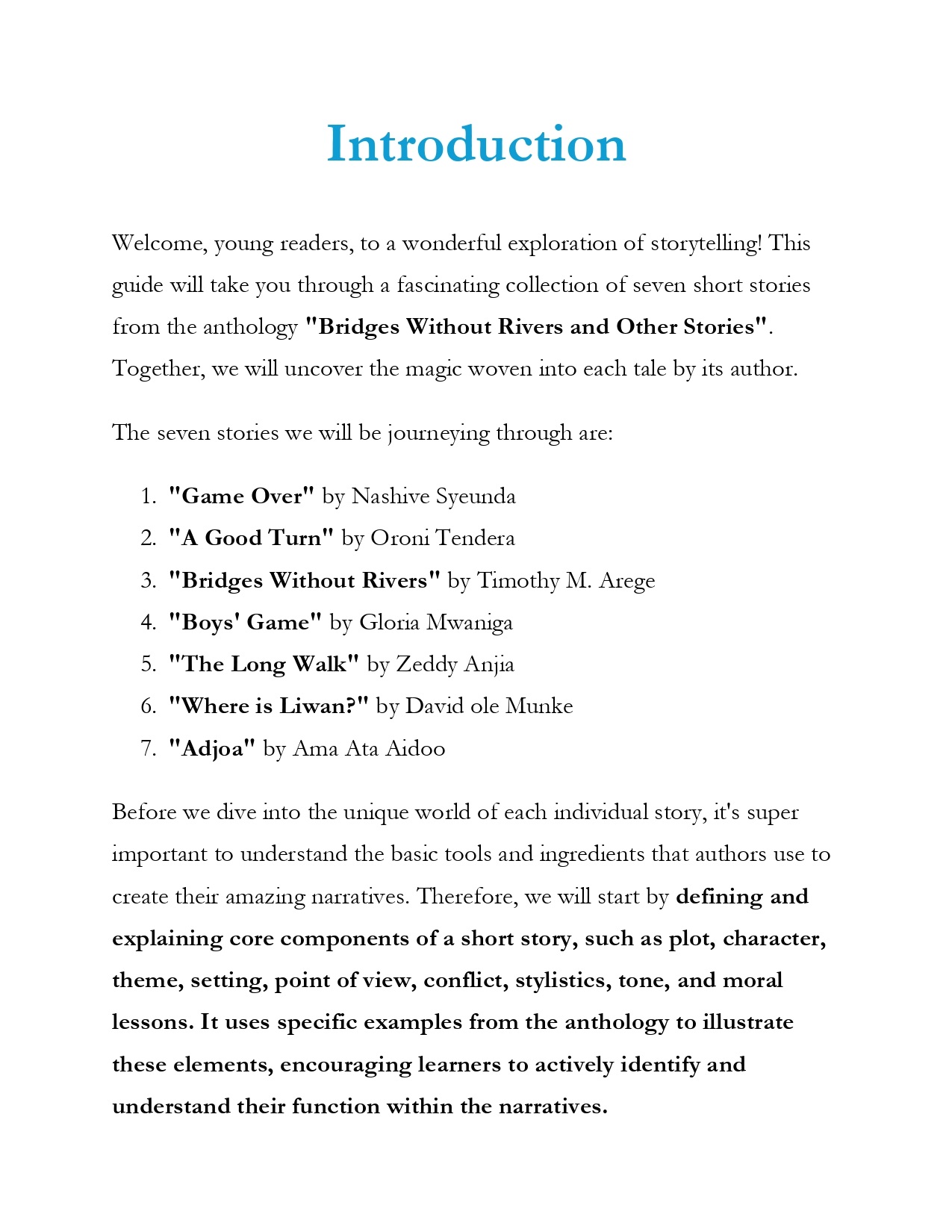
This 38-page PDF document contains comprehensive Bridges Without Rivers Summary Notes , a KICD-approved Grade 8 class reader in Kenya.
The notes have been carefully prepared by Mwalimu Focus, a trusted provider of high-quality educational content, with the Grade 8 Kenyan learner at the forefront. While designed to empower learners directly, the material is also an excellent teaching aid for teachers handling the class reader.
Structure of the Summary Notes
The document is well organized into two main parts, ensuring learners build strong foundational knowledge before engaging with individual stories.
Part A: Understanding the Short Story (Foundation Section)
Before analyzing individual texts, Mwalimu Focus introduces learners to the concept and structure of a short story, helping them understand how stories work. This section:
Defines what a short story is
Explains the essential elements of a short story in detail
Key Elements Covered
Plot – Understanding the sequence of events and how the story unfolds
Setting – Identifying where and when the story takes place and its impact
Characters – Analyzing the people or beings in the story and their traits
Themes – Uncovering the main ideas or messages
Point of View – Recognizing who is telling the story
Conflict – Understanding the struggles characters face
Stylistics – Appreciating the literary devices used by authors
Tone – Discerning the author’s attitude
Moral Lesson – Drawing out lessons learned
To enhance understanding, examples are drawn directly from the stories in the anthology, encouraging learners to compare how these elements appear across different narratives.
Part B: Analysis of Individual Short Stories
This section focuses on the detailed analysis and comprehension of each story in the class reader. For every story, learners are guided through:
Themes
Characters
Plot development
Stylistic devices
Key lessons
Stories Covered
1. Game Over – Nashive Syeunda
The story follows Lengai, a skilled sharpshooter drawn into rhino poaching under pressure from Mugeni and the mastermind Chung Ling. His journey is marked by moral conflict and a suspenseful, unresolved ending that questions justice.
Key Themes:
Effects of wildlife poaching
Greed and corruption
Betrayal by authority
Moral integrity under pressure
2. A Good Turn – Oroni Tendera
Wanjala, a young boy bent on revenge, encounters the deceitful Mr. Juma. Through unexpected events, Wanjala experiences moral growth and plays a role in bringing wrongdoing to justice.
Key Themes:
Deception versus trust
Forgiveness
Moral transformation
Child safety
3. Bridges Without Rivers – Timothy M. Arege
The story highlights Babito’s frustration after visiting his political representative, Buheri, whose empty promises symbolize ineffective leadership.
Key Themes:
Poor governance
Political disillusionment
Poverty
Gender roles in society
4. Boys’ Game – Gloria Mwaniga
Narrated by Mmbone, a girl growing up in a slum, the story depicts harsh childhood games that end tragically with the accidental death of Willy.
Key Themes:
Childhood poverty
Gender dynamics
Bullying
Resilience and loss
5. The Long Walk – Zeddy Anjia
Using flashbacks, the story explores Kamilu’s struggles after losing his job for refusing to engage in corruption, his divorce, and his search for justice.
Key Themes:
Integrity versus corruption
Coping with trauma
Loneliness
Hope and resilience
6. Where Is Liwan? – David ole Munke
Set in a pastoralist community, the story recounts the disappearance of Liwan near Lake Empaso and the community’s united effort to find and heal him.
Key Themes:
Responsibility
Community unity
Cultural traditions
Fear of the unknown
7. Adjoa – Ama Ata Aidoo
Told by seven-year-old Adjoa, the story captures her struggle with self-esteem due to her grandmother’s criticism and her eventual triumph through school athletics.
Key Themes:
Self-esteem
Intergenerational relationships
Impact of adults’ words
Personal achievement
Helpful Vocabulary Section
To enhance comprehension, the document includes a Helpful Vocabulary section that:
Defines key literary terms
Explains challenging words used in the notes
Improves learner confidence and understanding
Who Can Use These Notes?
Teachers: A ready-to-use resource for structured teaching and lesson preparation
Parents: Ideal for supporting Grade 8 learners at home
Students: Simplifies content, improves comprehension, and boosts performance in English and Literature
📘 Ready for Printing
The document is neatly organized, learner-friendly, and print-ready, making it a practical and effective study companion.
Preview first pages below for more details