What to expect:
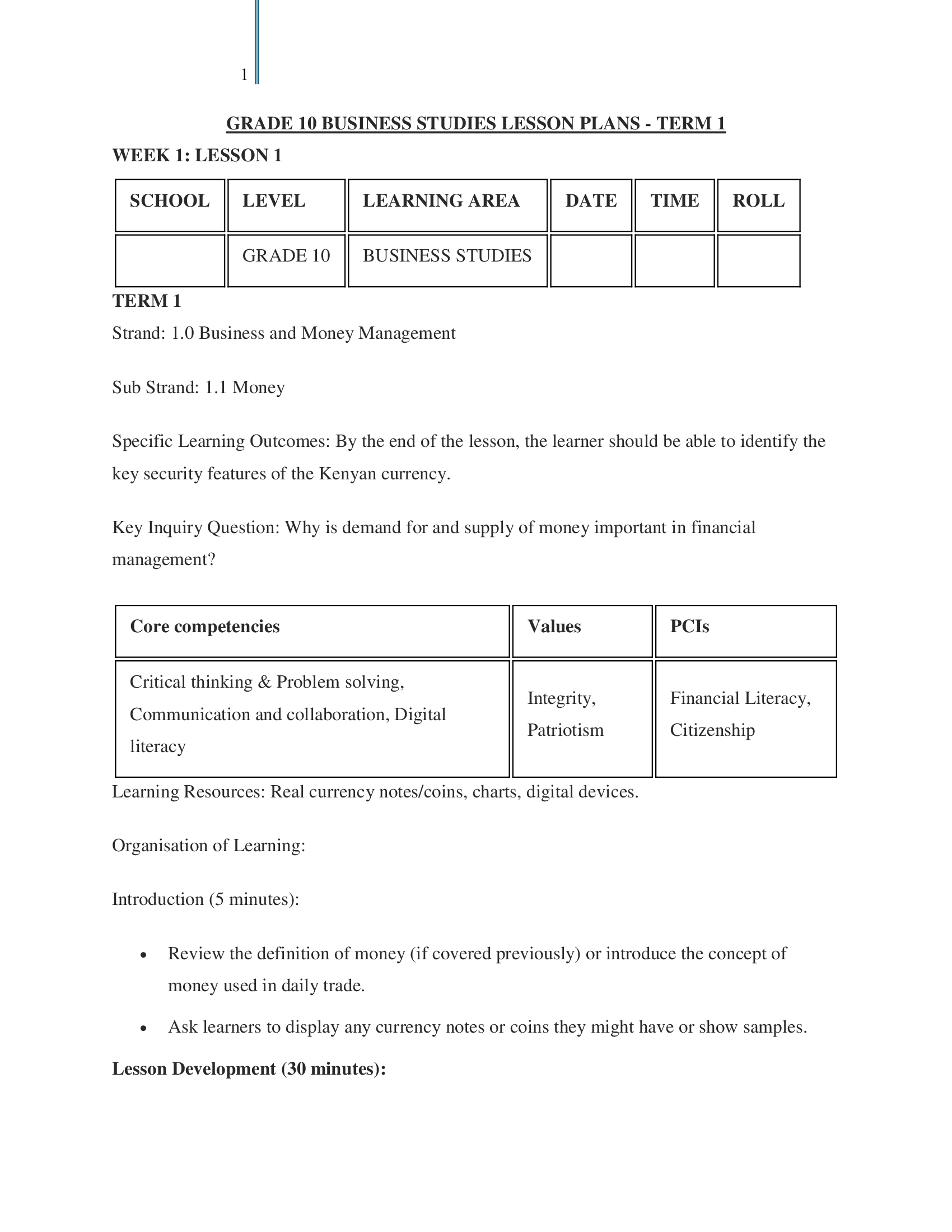
Title: Grade 10 Business Studies Lesson Plans Term 1
- Class:Grades 10
- Level:Senior Secondary
- Document Type:Ms Word Doc (Editable)
- Number of Pages: 92
Summary
The MS Word document comprises Grade 10 Business Studies Lesson Plans Term 1 2026. The PDF version is also available upon your request.
The lesson plans are structurally organized to cover 13 weeks, with a comprehensive schedule of 6 lessons per week, ensuring adequate time for deep engagement with the content. The entire plan is strictly aligned with the KICD-approved CBE curriculum, focusing on learner-centered activities and core competencies.
Strand 1.0: Business and Money Management
Sub-strand 1.1: Money
Key security features of Kenyan currency
Themes depicted on Kenyan currency
Functions of money: Medium of exchange and Measure of value
Functions of money: Store of value and Standard of deferred payment
Transactionary motive for demanding money
Precautionary and Speculative motives for demanding money
Factors determining the supply of money in an economy
Ethical and unethical practices on the use of money
Role of money in day-to-day life
Sub-strand 1.2: Business Goals
Meaning and importance of business goals
Internal and external factors to consider when setting business goals
Steps followed when setting business goals
SMART criteria for goals (Specific, Measurable, Achievable, Realistic, Time-bound)
Formulating SMART short-term and long-term goals
Distinction between short-term and long-term goals
Evaluating the viability of set goals
Sub-strand 1.3: Budgeting in Business
Meaning and importance of budgeting in business
Types of budgets: Sales, Production, Cash, and Capital budgets
Analysis of the Master Budget
Factors influencing budgeting and the budgeting process
Preparation of simple income and expenditure budgets
Preparation of surplus and deficit budgets
Sub-strand 1.4: Banking
Meaning and importance of banking in an economy
Types of accounts: Savings, Current, and Fixed Deposit accounts
Procedure of opening and operating a bank account
Ethical and unethical practices in banking
Trends in banking: Mobile banking, Agency banking, and Internet banking
Strand 2.0: Business and its Environment
Sub-strand 2.1: Business Activities
Concept of needs and wants
Types and characteristics of economic resources
Relationship between scarcity, choice, and opportunity cost
Preparation of a scale of preference
Classification of business activities
Micro and macro factors affecting business activities
Sub-strand 2.2: Types of Business Ownership
Sole Proprietorship: Meaning, formation, management, and sources of finance
Advantages and disadvantages of Sole Proprietorship
Partnerships: Meaning, types, formation, and partnership deed
Management, sources of finance, and dissolution of Partnerships
Cooperative Societies: Meaning, principles, formation, and registration
Types of Cooperative Societies (Producer, Consumer, SACCOs)
Management and sources of finance for Cooperatives
Comparison of different forms of business ownership
Sub-strand 2.3: Social Responsibility of Business
Justification for social responsibility of a business (CSR)
Examination of social responsibility activities in the community
Challenges faced in carrying out social responsibilities
Designing and implementing a social responsibility activity
Assessment
Term 1 Examination (Papers 1 and 2)
Reflection on term performance and holiday assignments
Preview first pages below for more details