What to expect:
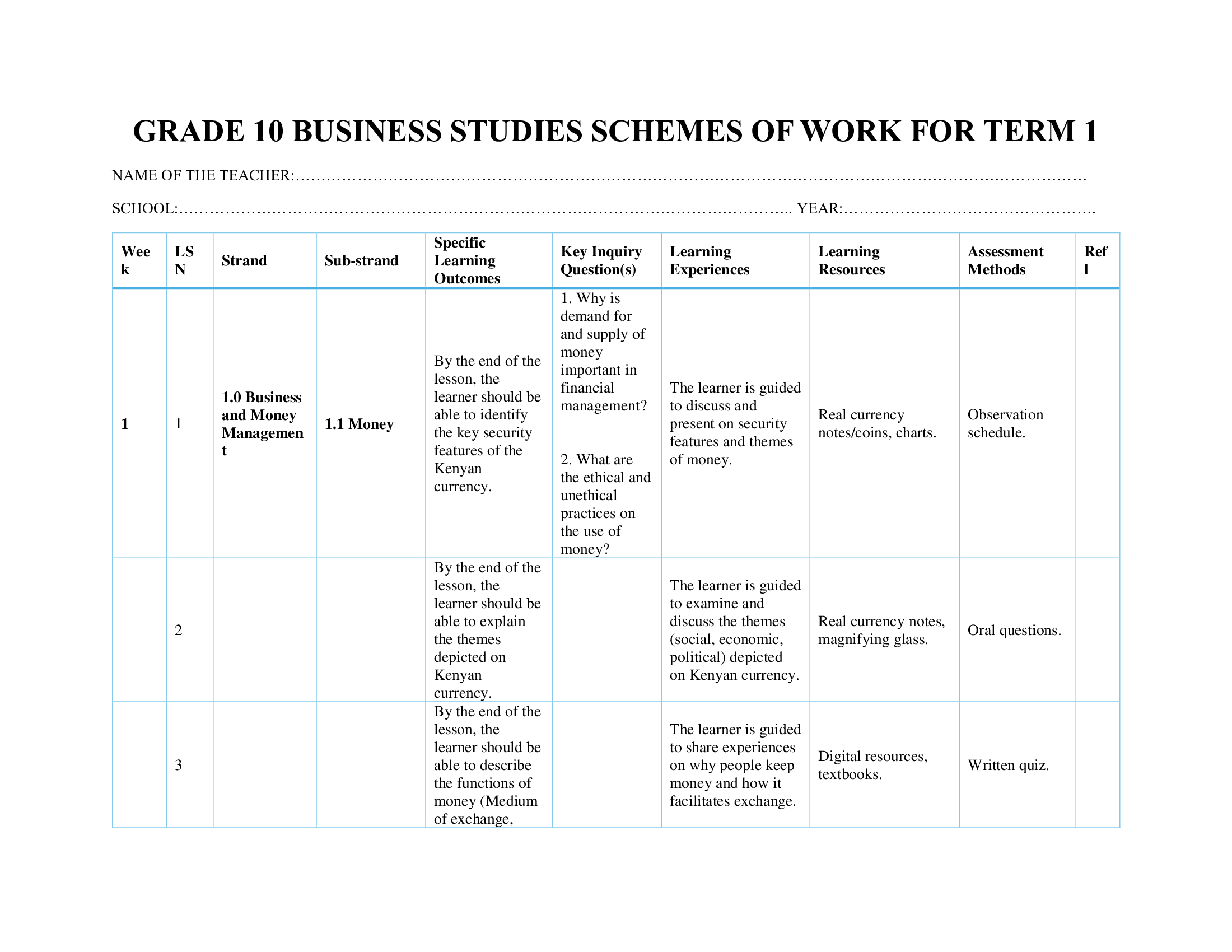
Title: Grade 10 Business Studies Schemes of Work Term 1
- Class:Grade 10
- Level:Senior Secondary
- Document Type:Ms Word Doc (Editable)
- Number of Pages: 17
Document Price:KSh 70.00
Summary
The MS Word document comprises Grade 10 Business Studies Schemes of Work Term 1 2026. The PDF version is also available upon your request.The schemes of work covers 6 lessons per week.The main reference material is the KICD Curriculum Design for Business Studies.The document covers the following strands, sub-strands, and topics:
- Strand 1.0: Business and Money Management
- Sub-strand 1.1: Money
- Key security features and themes of the Kenyan currency.
- Functions of money (Medium of exchange, Measure of value, Store of value, Standard of deferred payment).
- Demand for money (Transactionary, Precautionary, and Speculative motives).
- Factors determining the supply of money in an economy.
- Ethical and unethical practices on the use of money (e.g., money laundering).
- Sub-strand 1.2: Business Goals
- Meaning and importance of goal setting in business.
- Internal and external factors to consider when setting business goals.
- SMART criteria for goals (Specific, Measurable, Achievable, Realistic, Time-bound).
- Formulating SMART short-term and long-term business goals.
- Sub-strand 1.3: Budgeting in Business
- Meaning and importance of budgeting for financial control.
- Types of budgets (Sales, Production, Cash, Capital, and Master budget).
- Factors influencing budgeting and the budgeting process.
- Preparation of simple income, expenditure, and surplus/deficit budgets.
- Sub-strand 1.4: Banking
- Meaning and importance of banking in an economy.
- Types of accounts offered by banks (Savings, Current, Fixed Deposit).
- Procedure for opening and operating a bank account.
- Trends in banking in Kenya (Mobile banking, Agency banking, Internet banking).
- Sub-strand 1.1: Money
- Strand 2.0: Business and its Environment
- Sub-strand 2.1: Business Activities
- Concept of needs and wants and the role of business activities.
- Types and characteristics of economic resources (Scarcity, Utility).
- Relationship between scarcity, choice, and opportunity cost.
- Classification of business activities and environmental factors (micro and macro).
- Sub-strand 2.2: Types of Business Ownership
- Sole Proprietorship: Formation, management, sources of finance, advantages, and disadvantages.
- Partnerships: Meaning, types, formation (Partnership Deed), dissolution, advantages, and disadvantages.
- Cooperative Societies: Principles, formation, types (Producer, Consumer, Savings/Credit), management, and financing.
- Sub-strand 2.3: Social Responsibility of Business
- Justification for social responsibility (CSR) in business.
- Examining CSR activities in the community and challenges faced.
- Designing and implementing a social responsibility activity.
- Sub-strand 2.1: Business Activities
Preview first pages below for more details