What to expect:
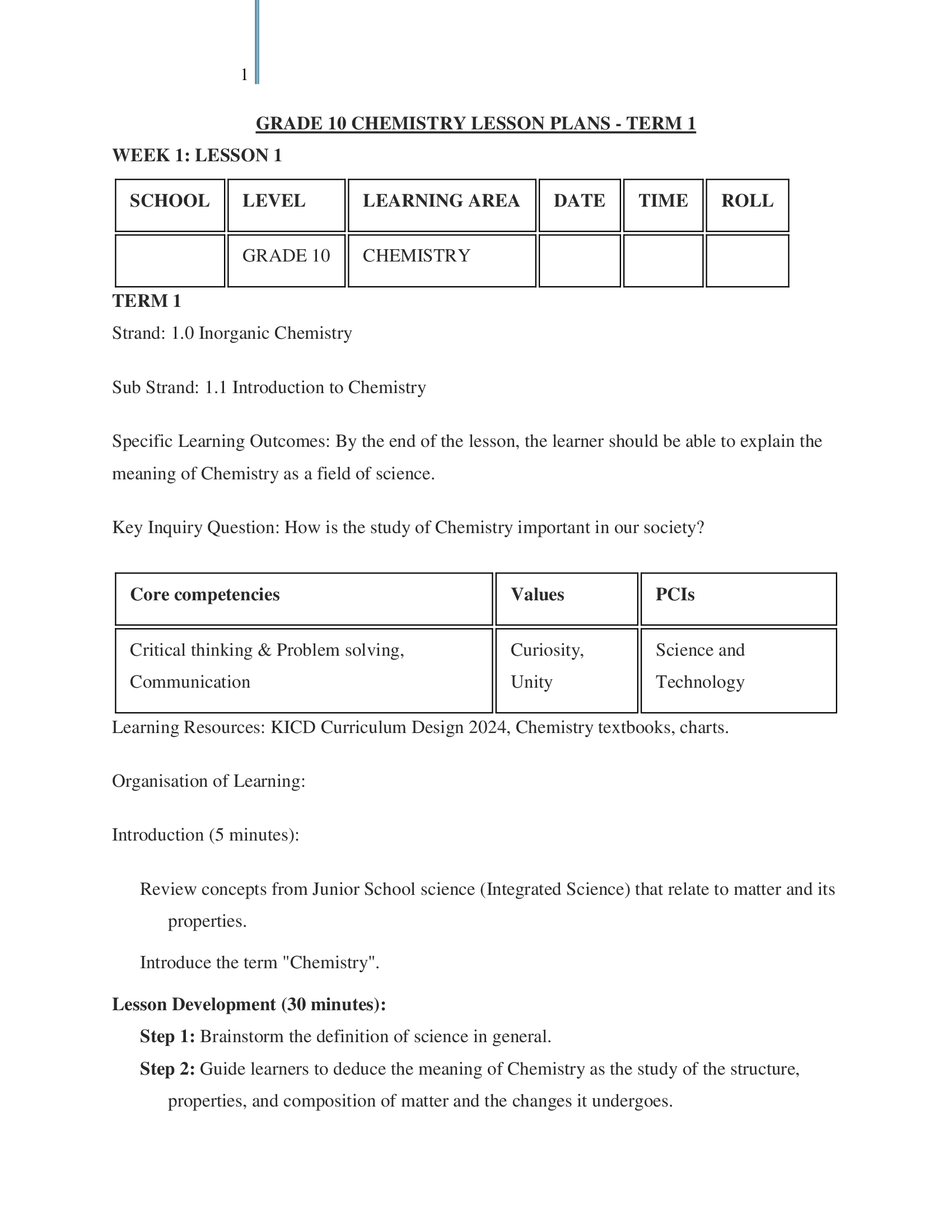
Title: Grade 10 Chemistry Lesson Plans Term 1
- Class:Grades 10
- Level:Senior Secondary
- Document Type:Ms Word Doc (Editable)
- Number of Pages: 58
Summary
The MS Word document comprises Grade 10 Chemistry Lesson Plans Term 1 2026. The PDF version is also available upon your request.
The lesson plans are structured to cover a duration of 13 weeks, with a consistent schedule of 4 lessons per week. The content is meticulously aligned with the KICD-approved CBE curriculum, emphasizing inquiry-based learning and practical applications of chemical principles.
Strand 1.0: Inorganic Chemistry
Sub-strand 1.1: Introduction to Chemistry
Meaning of Chemistry as a field of science
Branches of Chemistry (Organic, Inorganic, Physical)
Role of Chemistry in day-to-day life and career opportunities
Effects of drug and substance use
Consumer protection and safety regarding drugs and chemicals
Sub-strand 1.2: The Atom
Structure of the atom and sub-atomic particles (Protons, Neutrons, Electrons)
Atomic number, Mass number, and calculation of neutrons
Development of atomic models: Dalton’s model and Rutherford’s model
Isotopes: Definition and calculation of Relative Atomic Mass (RAM)
Energy levels and orbitals (s and p orbitals)
Order of filling electrons (Aufbau Principle, Pauli Exclusion, Hund’s Rule)
Writing electron arrangements for elements 1–20 using s and p notation
Modelling the structure of the atom
Stability of atoms: Octet and Duplet rules
Formation of Cations and Anions
Isoelectronic series and electron arrangement of ions
Inferring Valency and Oxidation Numbers from electron arrangement
Sub-strand 1.3: The Periodic Table
History and development of the Periodic Table (Periodic Law)
Relating element position to electron arrangement (Groups and Periods)
Identification and properties of Chemical Families:
Alkali Metals (Group 1)
Alkaline Earth Metals (Group 2)
Halogens (Group 7)
Noble Gases (Group 8/0)
Transition Elements
Variable oxidation numbers and naming of compounds
Radicals (Polyatomic ions) and their valencies
Deriving formulae for binary compounds and compounds with radicals
Writing and balancing chemical equations for:
Synthesis/Combination reactions
Decomposition reactions
Displacement reactions
Assessment and Closing
Term 1 Examinations (Paper 1 and Paper 2/Practical)
Reflection on term performance and holiday assignments
Preview first pages below for more details