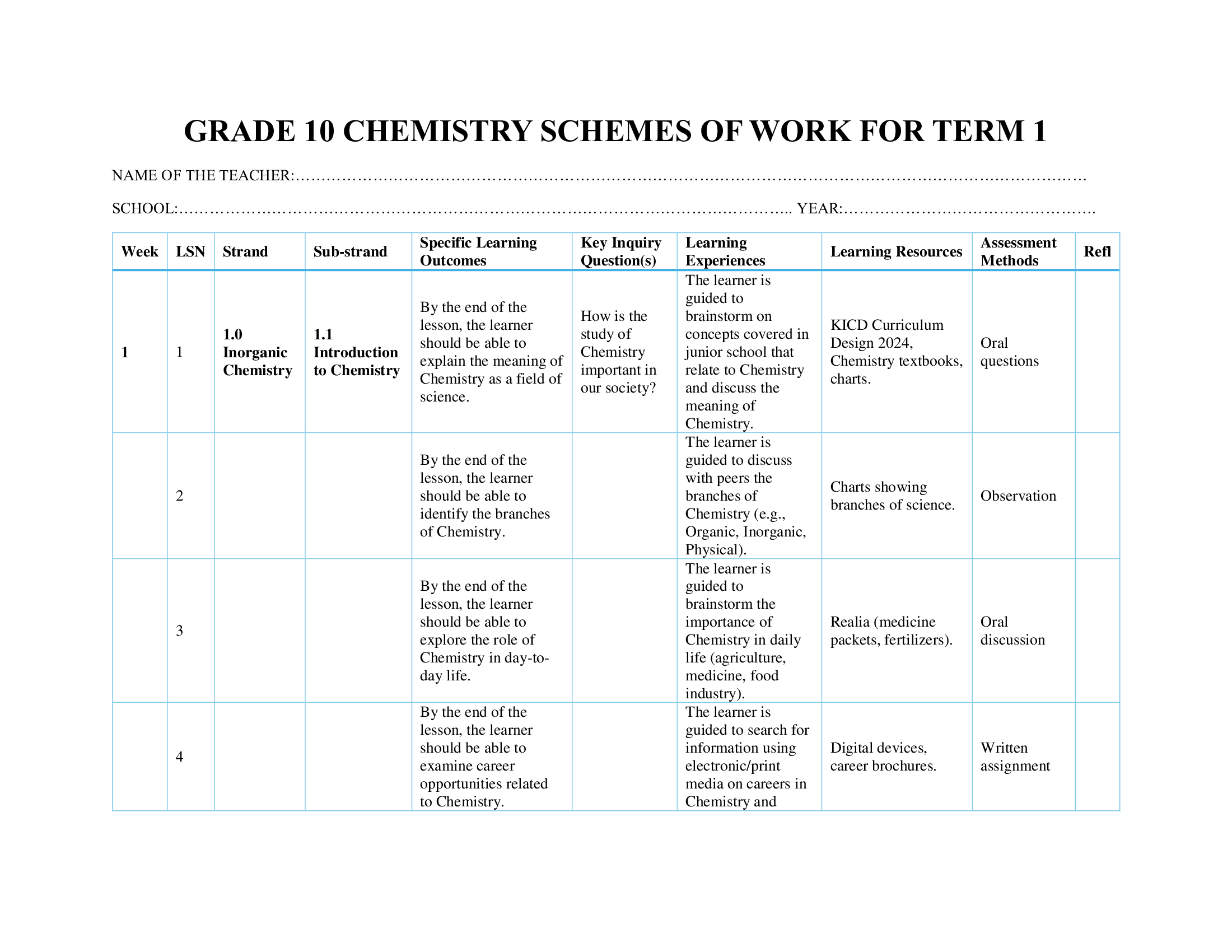
What to expect:
Title: Grade 10 Chemistry Schemes of Work for Term 1
- Class:Grade 10
- Level::Senior Secondary
- Document Type:Ms Word Doc (Editable)
- Number of Pages: 9
Summary
The MS Word document contains Grade 10 Chemistry Schemes of Work for Term 1, 2026.
A PDF version can also be provided upon request.
The schemes are structured to cover 4 lessons per week and follow the KICD Curriculum Design for Chemistry as the primary reference.
Content Overview
The document comprehensively covers the following strands, sub-strands, and key topics:
Strand 1.0: Inorganic Chemistry
Sub-strand 1.1: Introduction to Chemistry
Meaning and major branches of Chemistry: Organic, Inorganic, and Physical Chemistry.
Importance of Chemistry in daily life, including agriculture, medicine, and the food industry.
Career opportunities in Chemistry and addressing gender stereotyping in science fields.
Drug and substance use: prescription, dosage, misuse, and associated risks.
Consumer protection: rights and responsibilities related to drug safety.
Sub-strand 1.2: The Atom
Review of atomic structure, including atomic number and mass number.
Illustration of early atomic models: Dalton’s model and Rutherford’s model.
Understanding isotopes and calculating Relative Atomic Mass (RAM).
Energy levels and orbitals, focusing on electron filling in s and p orbitals.
Electron configuration for elements 1–20 using s and p notation.
Modeling atomic structure using locally available materials.
Stability of atoms and prediction of ion formation (cations and anions).
Deriving valency and oxidation numbers from electron arrangements.
Sub-strand 1.3: The Periodic Table
Relationship between electron configuration and the position of an element in the Periodic Table (Groups and Periods).
Identification of chemical families: Alkali Metals, Alkaline Earth Metals, Halogens, Noble Gases, and Transition Elements.
Elements with variable oxidation states.
Identification of common radicals and deriving chemical formulae for binary and complex compounds.
Writing and balancing chemical equations, including synthesis, decomposition, and displacement reactions.
Preview first pages below for more details