What to expect:
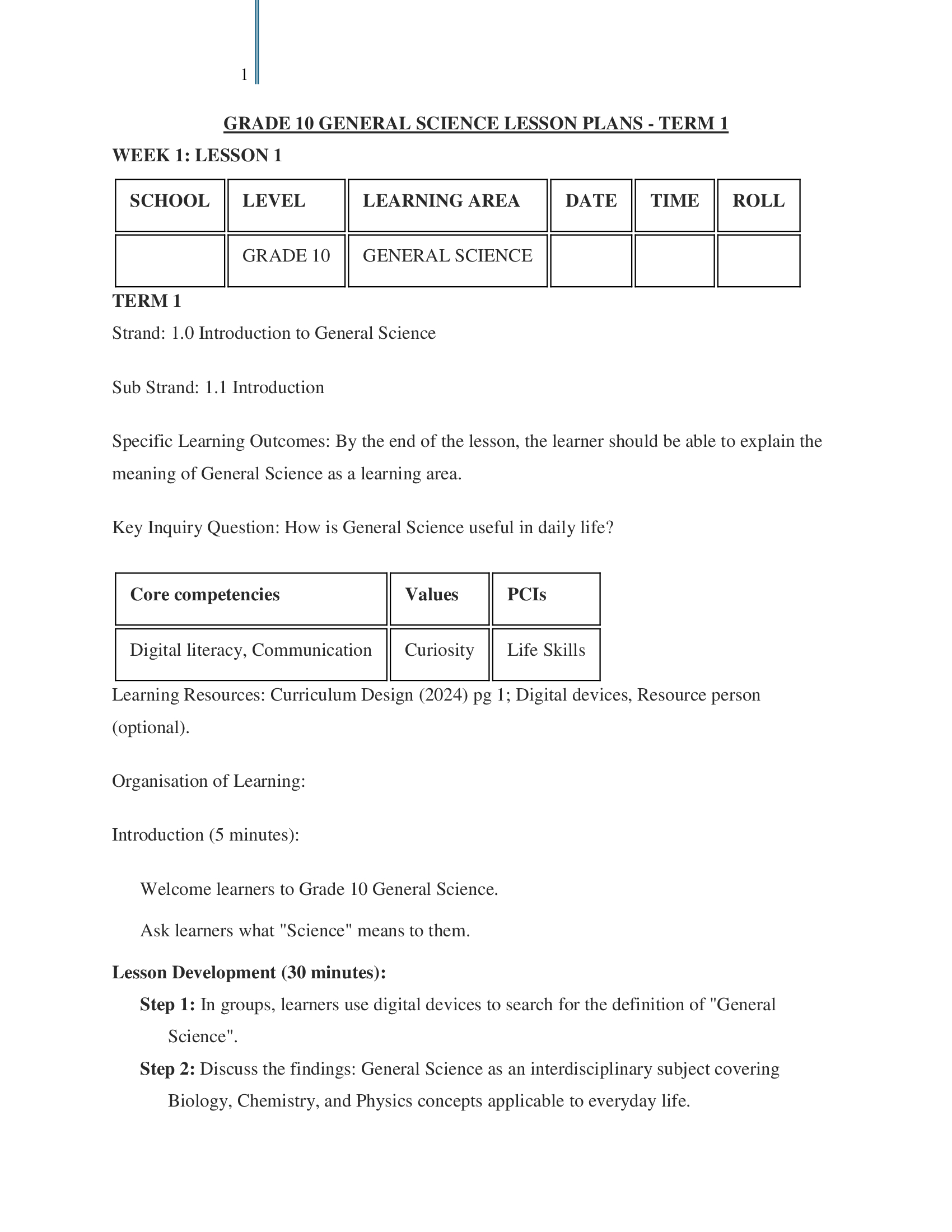
Title: Grade 10 General Science Lesson Plans Term 1
- Class:Grades 10
- Level:Senior Secondary
- Document Type:Ms Word Doc (Editable)
- Number of Pages: 73
Summary
The MS Word document comprises Grade 10 General Science Lesson Plans Term 1 2026. The PDF version is also available upon your request.
The lesson plan covers a duration of 12 weeks, with a Mid-Term Break scheduled for Week 8. It is structured with 6 lessons per week, ensuring comprehensive coverage of the syllabus. The lesson plan is aligned with the KICD-approved CBE curriculum.
Strand 1.0: Introduction to General Science
Sub Strand 1.1: Introduction
Explaining the meaning of General Science as a learning area.
Discussing the branches of General Science (Biology, Chemistry, Physics).
Outlining the importance of General Science in life, environment, and technology.
Identifying career opportunities related to General Science.
Strand 2.0: Living Things and Environment
Sub Strand 2.1: The Cell
Explaining the differences between light and electron microscopes.
Describing the plant cell under an electron microscope (organelles and functions).
Describing the animal cell under an electron microscope.
Comparing plant and animal cell structures.
Explaining the functions of the components of plant and animal cells.
Constructing a concept map of the levels of cell organisation (Organelles to Organism).
Sub Strand 2.2: Nutrition in Animals
Describing digestion of food in the mouth and stomach.
Describing digestion of food in the small intestine (enzymes and absorption).
Explaining the adaptations of parts of the human digestive system (Mouth, Oesophagus, Stomach, Intestines).
Performing experiments to determine the presence of Starch (Iodine test).
Performing experiments to determine the presence of Reducing Sugars (Benedict’s test).
Performing experiments to determine the presence of Proteins (Biuret test).
Performing experiments to determine the presence of Lipids (Grease spot and Emulsion tests).
Appreciating the role of different parts of the digestive system (Model making project).
Presenting digestive system models.
Sub Strand 2.3: Transport in Plants
Describing transport in plants (Xylem and Phloem overview).
Identifying tissues responsible for transport (Monocot and Dicot stems).
Describing absorption of water in plants (Osmosis and Root Pressure).
Describing absorption of mineral salts in plants (Diffusion and Active Transport).
Investigating structural factors affecting transpiration (Leaf surface, cuticle, stomata).
Investigating environmental factors affecting transpiration (Wind, Humidity, Light, Temperature).
Investigating translocation in plants (Ring-barking experiment).
Describing the significance of transpiration and the necessity of transport.
Sensitizing the community on transport in plants (Plant care project).
Sub Strand 2.4: Respiration
Explaining the meaning of respiration and the role of mitochondria.
Describing aerobic respiration (Equation and energy yield).
Describing anaerobic respiration (Animals vs Plants/Yeast).
Investigating anaerobic respiration (Fermentation experiment).
Explaining the effects of anaerobic respiration (Oxygen debt, Muscle fatigue).
Calculating the Respiratory Quotient (RQ).
Explaining factors affecting respiration (Temperature, Oxygen, Substrate, Age).
Describing the economic importance of anaerobic respiration (Baking, Brewing, Biogas).
Sub Strand 2.5: Plant Growth and Development
Explaining the meaning of growth and development.
Describing the causes of seed dormancy.
Determining how to break seed dormancy (Scarification, Soaking, etc.).
Determining conditions necessary for germination (Water, Oxygen, Warmth).
Differentiating between epigeal and hypogeal germination.
Observing germination progress and experimental results.
Distinguishing between primary and secondary growth.
Describing the role of growth hormones (Auxins and Tropisms).
Appreciating the concept of growth in plants (Field visit).
Sub Strand 2.6: Microorganisms
Identifying microorganisms that affect human beings (Bacteria, Fungi, Viruses, Protozoa).
Explaining modes of transmission of microorganisms.
Identifying types of infections caused by fungi (Ringworm, Athlete’s foot).
Identifying types of infections caused by bacteria (Cholera, Typhoid, TB).
Identifying types of infections caused by viruses (Flu, HIV, COVID-19).
Describing methods of control of infections (Hygiene, Vaccination, Isolation).
Explaining the economic importance of microorganisms (Beneficial uses).
Appreciating the effect of microorganisms in life (Friend vs Foe debate).
Analyzing data on microorganism-related diseases.
Developing guidelines for prevention (Pamphlet design).
Performing a project on microorganisms (Bread mould or Yoghurt making).
Strand: Assessment
Sub Strand: End Term One Assessment
End Term One Assessment (Paper 1: Theory).
End Term One Assessment (Paper 2: Practical/Project Assessment).
Strand: Closing
Sub Strand: Reflect & Close
Reflection on Term 1 performance and holiday assignments.
Preview first pages below for more details