What to expect:
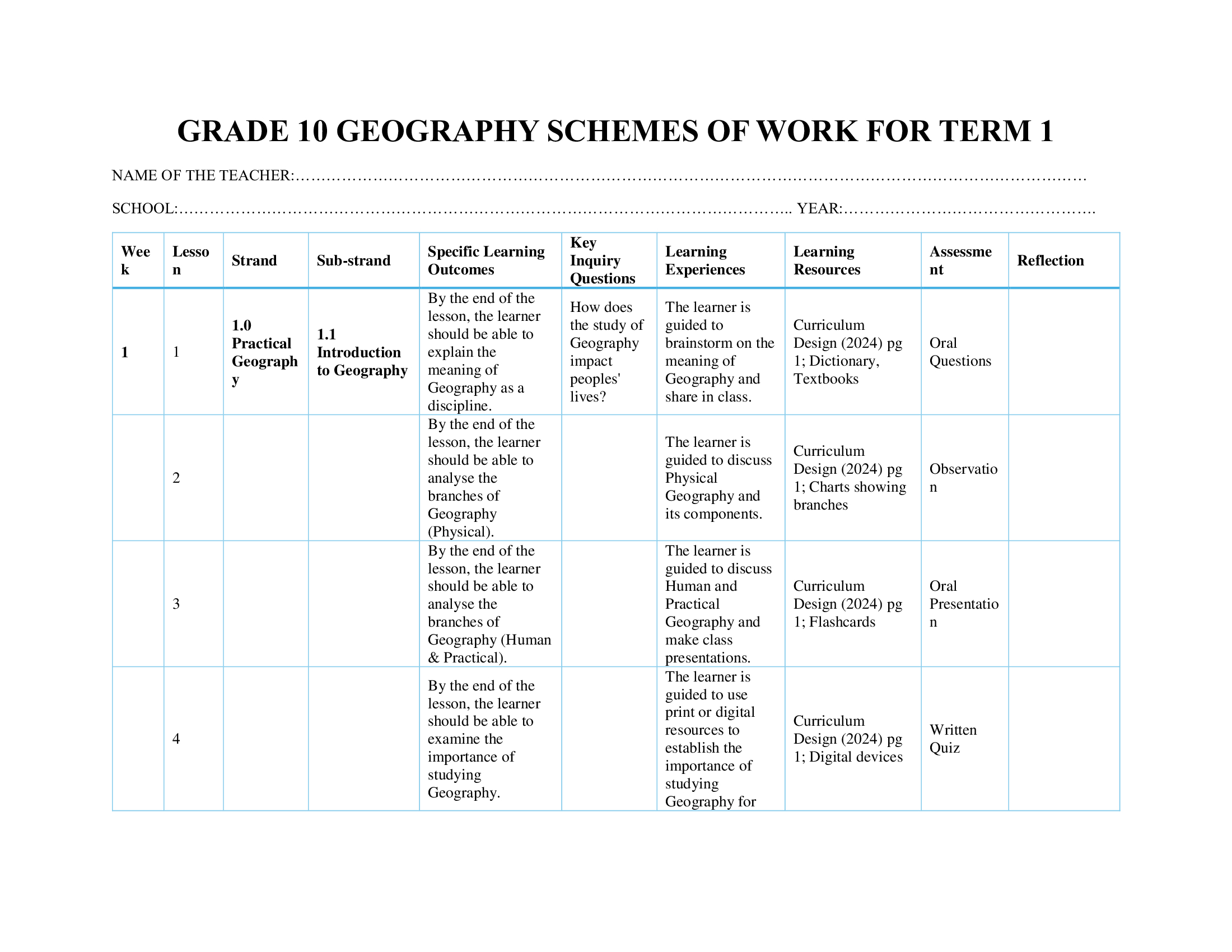
Title: Grade 10 Geography Schemes of Work for Term 1
- Class:Grade 10
- Level:Senior Secondary
- Document Type:Ms Word Doc (Editable)
- Number of Pages: 8
Summary
This MS Word document comprises Grade 10 Geography Schemes of Work for Term 1, 2026.
A PDF version is also available upon request.
The schemes of work cover 5 lessons per week and follow the KICD Geography Curriculum Design for Senior School.
Strands and Sub-Strands Covered
1.0 Introduction to Geography
1.1 Meaning and branches of Geography
1.2 Importance of studying Geography
1.3 Relationship between Geography and other subjects
2.0 The Earth and the Solar System
2.1 The Solar System
2.2 The shape and size of the Earth
2.3 Proofs of the Earth’s shape
2.4 Rotation and revolution of the Earth and their effects
3.0 Map Work
3.1 Map reading and interpretation
3.2 Map scales (statement, linear, ratio)
3.3 Directions and bearings
3.4 Grid references and marginal information
4.0 Weather and Climate
4.1 Elements of weather
4.2 Weather instruments and their uses
4.3 Recording, interpreting and presenting weather data
4.4 Factors influencing climate
5.0 The Environment and Its Resources
5.1 Types of natural resources
5.2 Conservation and sustainable use of resources
5.3 Human activities and environmental impact
Topics Covered Within These Sub-Strands
Introduction to Geography
Definition of Geography
Branches: Physical, Human, Practical Geography
Importance in careers, environment, and technology
The Earth and the Solar System
Components of the Solar System
Characteristics of planets
Evidence of Earth’s spherical shape
Day and night, seasons, time zones, and varying lengths of day/night
Map Work
Conventional signs and symbols
Types of scales and their uses
Cardinal and intercardinal points
Measuring distances and calculating areas on maps
Using grid references and map keys
Weather and Climate
Temperature, rainfall, humidity, wind, sunshine, pressure
Use of thermometers, hygrometers, barometers, wind vanes, rain gauges
Drawing simple weather graphs: bar graphs, line graphs
Distinguishing weather from climate
Factors influencing climate: latitude, altitude, winds, ocean currents
Environment and Resources
Renewable and non-renewable resources
Water, soil, forests, wildlife
Causes of environmental degradation
Conservation practices
Role of individuals and communities in environmental management
Main Reference Material
Preview first pages below for more details