What to expect:
Title: Grade 10 Music and Dance Schemes of Work for Term 1
- Class:Grade 10
- Level:Senior Secondary
- Document Type:Ms Word Doc (Editable)
- Number of Pages: 9
Summary
This MS Word document comprises the full Grade 10 Music and Dance Schemes of Work for Term 1, 2026.
A PDF version is also available upon request.
The schemes of work cover 6 lessons per week and follow the KICD-approved strands and sub-strands.
Strand 1.0: Foundations
Sub-strand 1.1: Rhythm
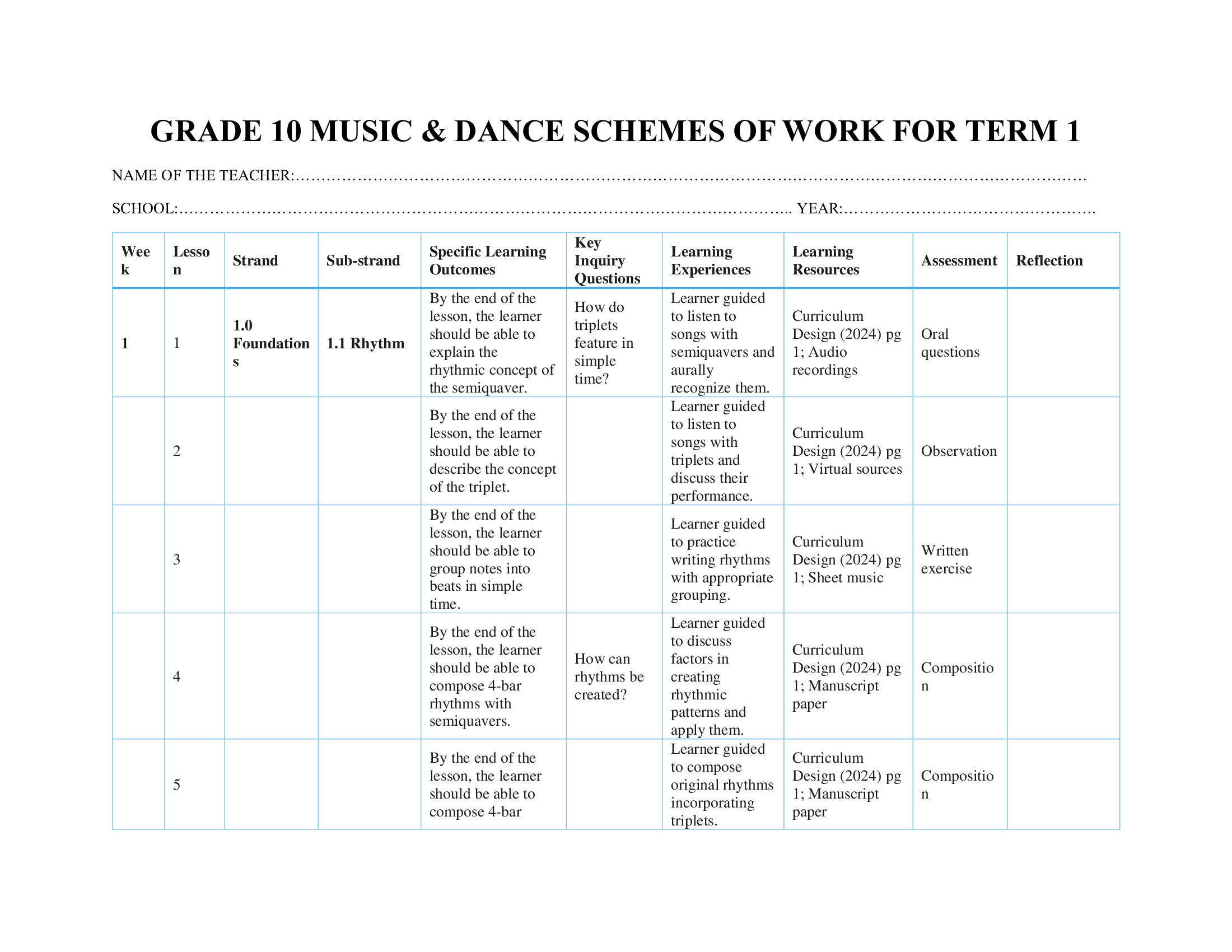
Rhythmic concept of the semiquaver.
Introduction to the triplet.
Grouping notes into beats in simple time.
Composing 4-bar rhythms using semiquavers and triplets.
Performing learner-created rhythms.
Appreciation and critique of rhythmic compositions.
Sub-strand 1.2: Melody in Major Keys
Description of melodic devices.
Construction of major scales on treble staff (D, A, Bb, Eb).
Construction of major scales on bass staff.
Composing 8-bar melodies incorporating devices and articulation marks.
Performance and critique of composed melodies.
Sub-strand 1.3: Transposition
Description of intervals in a major scale.
Concept of transposition.
Transposing music by given intervals (2nd, 3rd, 4th, 5th).
Transposing melodies an octave higher or lower.
Transposing between treble and bass staff.
Transposing music into specific keys: C, G, F, D, A, Bb, Eb.
Sub-strand 1.4: Setting Text to Music
Process of setting Kiswahili text to music.
Establishing text–melody relationships.
Selecting text on relevant issues (e.g., health, financial literacy).
Assigning rhythm and pitch to text.
Applying word-painting techniques.
Writing music in staff notation and performing the composed song.
Sub-strand 1.5: Two-Part Harmony
Guidelines for writing two-part harmony.
Identifying harmonic intervals (consonant and dissonant).
Composing a second part using consonance and appropriate motion (similar or contrary).
Scoring two-part harmony on the treble stave.
Recording two-part compositions.
Sub-strand 1.6: Music Notation Software
Identifying notation software (MuseScore, Sibelius, etc.).
Basic navigation of digital notation tools.
Keying in, editing, and formatting music.
Saving and exporting files (MIDI, audio, print formats).
Sub-strand 1.7: Dance Production
Elements of dance: Body, Action, Space.
Improvising props using locally available materials.
Designing theme-based costumes.
Understanding and describing choreography.
Selecting multimedia effects (sound and lighting).
Strand 2.0: Performing
Sub-strand 2.1: Kenyan Folk Songs
Characteristics of Kenyan folk songs.
Selecting folk songs with appropriate themes.
Sourcing instruments and costumes.
Assigning performance roles (soloist, group, instrumentalist).
Rehearsing and performing selected folk songs.
Main Reference:
KICD Curriculum Design for Music and Dance.
Preview first pages below for more details