What to expect:
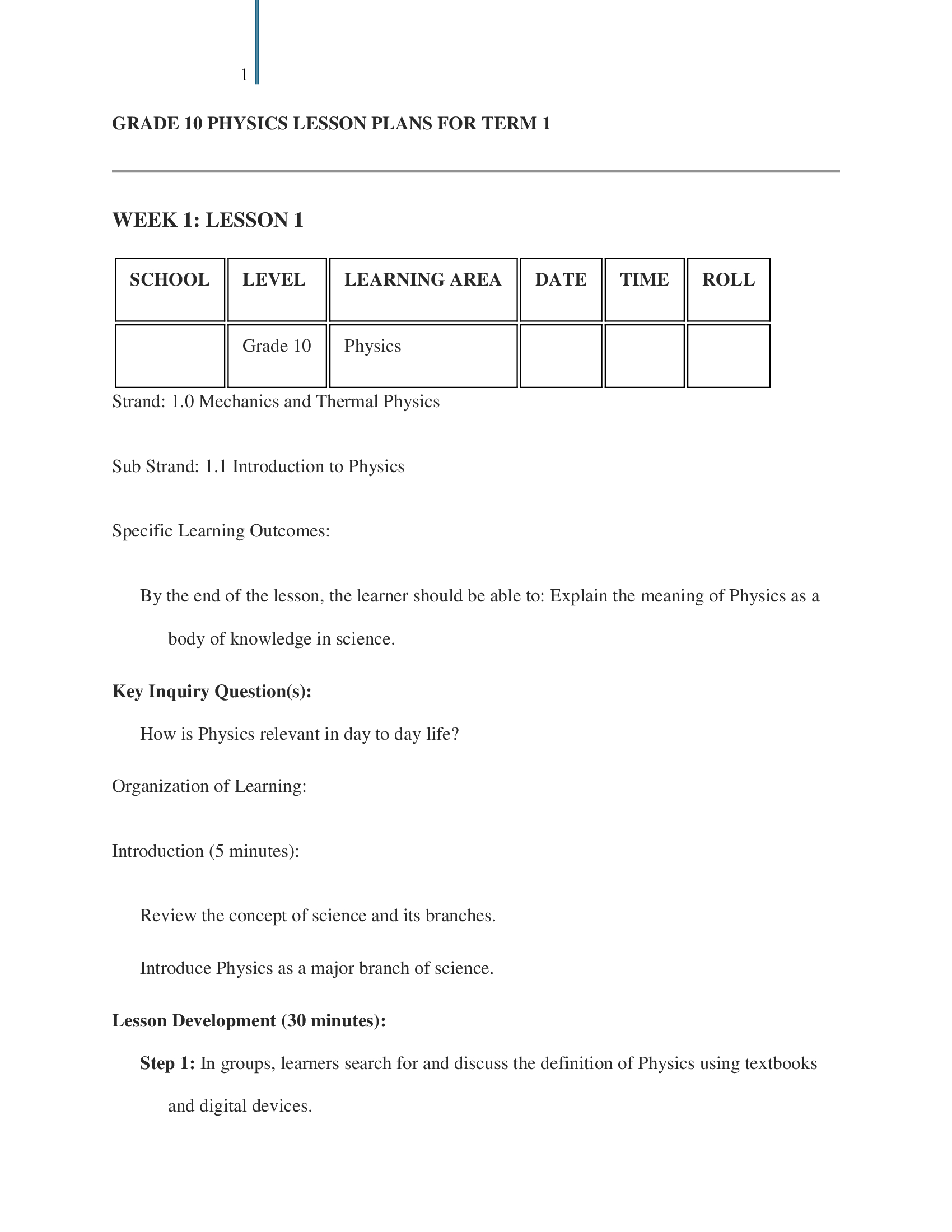
Title: Grade 10 Physics Lesson Plans Term 1
- Class:Grades 10
- Level:Senior Secondary
- Document Type:Ms Word Doc (Editable)
- Number of Pages: 51
Summary
The MS Word document comprises Grade 10 Physics Lesson Plans Term 1 2026.
The PDF version is also available upon your request.
🗓️ Lesson Plan Structure
Duration: 13 weeks
Mid-Term Break: Week 8
End-of-Term Assessments: Weeks 12 and 13
Lessons per Week: 4
Curriculum Alignment: KICD-approved CBE (Competency-Based Education) curriculum
📚 Covered Strands, Sub-Strands, and Topics
🔷 Strand 1.0: Mechanics and Thermal Physics
🔹 Sub Strand 1.1: Introduction to Physics
Meaning of Physics as a body of knowledge
Main branches of Physics
Importance of Physics in day-to-day life
Relationship between Physics and other fields of study
Career opportunities in the field of Physics
Creation of career charts
🔹 Sub Strand 1.2: Pressure
Description of atmospheric pressure
Demonstrating the existence of atmospheric pressure
Effect of density on pressure in fluids
Effect of depth on pressure in fluids
Derivation of the equation P = pgh
Application of P = pgh to determine pressure
Transmission of pressure in fluids (Pascal’s Principle)
Hydraulic systems:
Hydraulic Brakes
Hydraulic Jacks
Solving numerical problems on hydraulic systems
🔹 Sub Strand 1.3: Archimedes’ Principle
Definition of buoyancy and Archimedes’ principle
Verification of Archimedes’ principle by experiment
Applications:
Ships and Submarines
Floating and Buoyancy conditions
Hot air balloons
Life jackets
🔹 Sub Strand 1.3: Mechanical Properties of Materials
Importance of mechanical properties in day-to-day life
🔹 Sub Strand 1.4: Temperature and Thermal Expansion
Definition of thermal expansion
Factors affecting linear expansion
Experiment to demonstrate linear expansion of solids
Determining linear expansivity (alpha) of a solid
Factors affecting volume expansion
Solving numerical problems on linear expansivity
Meaning of temperature and its units
Measuring temperature using liquid expansion devices
Temperature measurement using bimetallic devices and thermocouples
Advanced temperature measurement technologies:
RTDs
Thermistors
Infrared
Investigating thermal expansion in solids (Ball and Ring experiment)
Investigating thermal expansion in fluids
Anomalous expansion of water
Applications:
Thermostats
Construction (railways, bridges, power lines)
📝 Strand Assessments
🔸 Sub Strand: End of Term Assessment
Administration of End of Term 1 Exams
Preview first pages below for more details